
Find Your Way: Navigation Skills for Hikers

Selected theme: Navigation Skills for Hikers. Step onto the trail with confidence, curiosity, and calm. This page is your friendly compass—blending practical techniques, memorable stories, and field-tested wisdom so you can plan smarter routes, adapt on the fly, and always know where you are. Subscribe for weekly drills, printable checklists, and inspiring navigation challenges tailored for real hikers.

Map Literacy That Keeps You Found

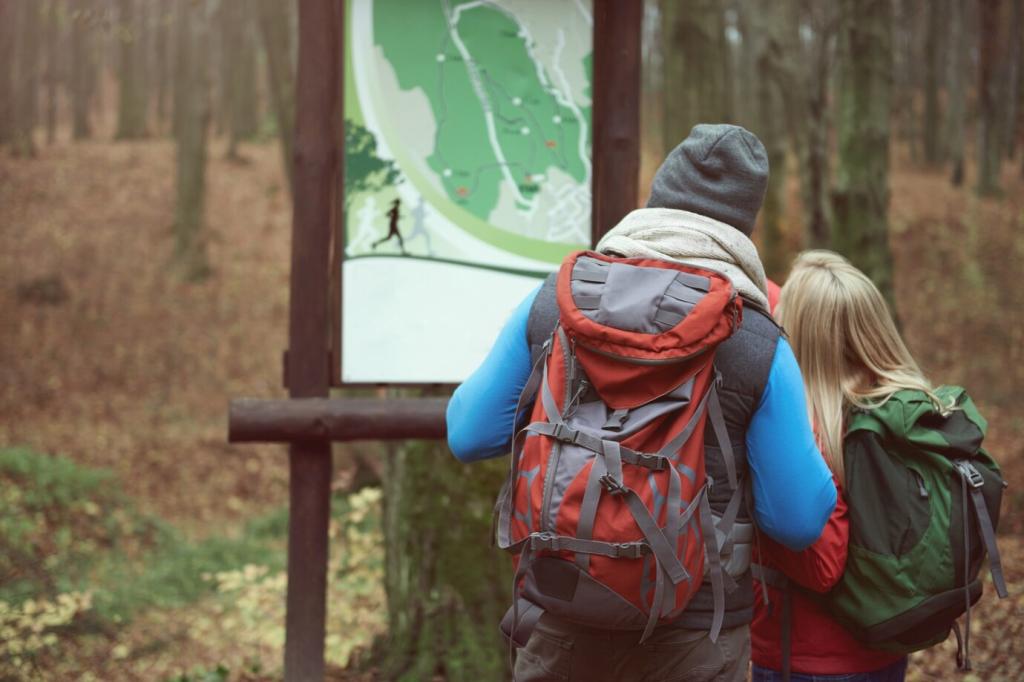
A topographic map is a conversation between you and the terrain. Learn how 1:24,000 compares to 1:50,000, why trail classifications matter, and how water features, vegetation boundaries, and human structures are symbolized. Share your favorite map series in the comments and tell us which symbols you rely on most.

Map Literacy That Keeps You Found

Contour lines reveal slope, shape, and elevation—tight lines mean steep ground, broad spacing means gentle terrain. Notice spurs, reentrants, saddles, and convex or concave profiles to anticipate effort and hazards. Practice by tracing a route at home, then walk it and compare expectations to reality. Report your most surprising contour lesson.

Smart Use of GPS and Apps

Waypoints, Tracks, and Battery Strategy

Create waypoints for trailheads, water sources, and decision gates. Record tracks sparingly to save power, and carry a lightweight power bank. Dim the screen, disable unnecessary radios, and keep devices warm in cold weather. Test your battery plan on a short hike, then share your actual versus expected usage.

Phone Navigation: Offline Maps Done Right

Before you lose service, download multiple offline layers—topo, satellite, and public land overlays. Verify datum settings and grid preferences, and label critical waypoints with notes. Keep a backup app in case one fails. Tell us which apps have the clearest contour shading for low-light reading.

Analog + Digital: Redundancy That Saves Days

Bring a paper map and baseplate compass even when your GPS is flawless. Cross-check your digital position with terrain association to catch drift early. If one tool disagrees, pause and diagnose rather than pushing ahead. Subscribe for our printable cross-check routine and field worksheet.

On-Trail Techniques You Can Practice Today

Know your 100-meter pace on trail, off trail, and uphill. Use pacing beads or mentally tally groups of ten. Pair pacing with time checks to estimate distance between checkpoints. If drift appears, stop early and correct. Try a pacing drill this weekend and share your results with the community.

Natural Navigation When Tools Fail

Plant a stick, mark the shadow tip, wait, and mark again—the line runs approximately west to east. Pair this with time of day and latitude awareness for better accuracy. Practice at lunch on your next hike and share your measured deviation from true direction.

Natural Navigation When Tools Fail

Tree flagging often points with prevailing winds; cornices form on leeward sides; snow surfaces crust differently depending on aspect. Lichens and moss may hint at moisture patterns but are unreliable alone. Combine multiple clues and verify with terrain. Comment with the most useful natural indicator in your region.
In featureless conditions, establish a bearing box with a tight left and right limit. Walk to visible markers, then reset on the bearing. Use reflective markers sparingly to avoid confusion. Practice on a soccer field at night and report how well your line held over 300 meters.
Keep visual contact using reflective patches and a lead hiker with a bright chest light. Use simple, pre-agreed voice or whistle signals for halts and turns. Rotate the lead to maintain focus. Share your team’s best communication protocol so others can adopt it on their next outing.
We once crossed a broad, grassy saddle in thick fog, pacing carefully and checking a bearing every fifty steps. Our catching feature—a rocky outcrop—appeared exactly where the contour sketch predicted. Confidence surged, fear faded, and we made camp on plan. Tell us your own night-navigation win.

Emergency Protocols If You Get Lost

Stop moving to halt compounding errors. Think through your last confirmed location. Observe with all senses and tools, from terrain to weather. Plan the smallest next action, often to return to the last known point. Share how you rehearse STOP during low-stakes practice hikes.

Emergency Protocols If You Get Lost

Use resection to find yourself: shoot bearings to two visible features, correct for declination, and draw lines back toward your position. Signal three whistle blasts for help. Conserve energy and warmth while you re-evaluate options. Comment with any SAR tips you have learned from local trainings.
Disputesurge
Privacy Overview

This website uses cookies so that we can provide you with the best user experience possible. Cookie information is stored in your browser and performs functions such as recognising you when you return to our website and helping our team to understand which sections of the website you find most interesting and useful.